
Value-First Consulting
We help organizations with our experience, expertise and co-innovation network, to ensure they achieve value from their investments in digital technologies and business models.
We use AI to accelerate our consulting engagements and improve the depths of insights and quality of outputs. We feed the AI with our best practices, lessons learned, frameworks and methodologies to get better results. We never feed proprietory information of our clients and partners into AI, as well as no personal data. We are aware that the results would be better if we would do it, but we make this trade-off, except our customers or partners explicitly allow us to do so.
Our trusted advisory model is:
- value-oriented
- vendor-neutral
- standards-based
- strategy-focused
- architecture-led
- AI-supported
- sustainability-inspired
Our offerings reflect our focus on asset-intensive industries and Industry 4.0.
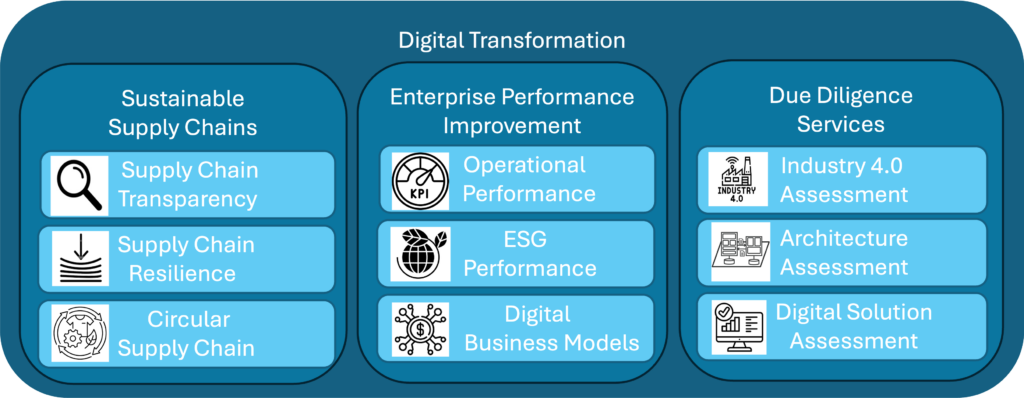
Digital Transformation
We help our clients with their digital transformation journey, focusing to 3 areas:
- Due Diligence Services: Where are you currently standing and where are the gaps to the desired target state.
- Enterprise Performance Improvement: How do you improve what you already have.
- Sustainable Supply Chains: Reshape your supply chain to be more competitive and achieve your Triple Bottom Line (https://online.hbs.edu/blog/post/what-is-the-triple-bottom-line).
Due Diligence Services
Industry 4.0 Assessment
Industry 4.0 is a broad spectrum of business and technology topics, but its core is how digital technologies can improve industrial organizations. The organization Plattform Industrie 4.0 has start many initiatives over the years with a focus to shape industry-driven standards that are then handed over to national, regional or International Standard Development Organizations, like ISO.
Architecture Assessment
Enterprise Architecture for us contains business and technology architecture. Both change over time and often do no longer support the strategic business and digital goals of an organization. Our assessment can look at both, business and technology operating model and compare it to industry best practices and emerging technologies and digital business models. While standard assessment models for software architecture, like ATAM, exist, in the areas of enterprise, domain and solution architecture, our assessments are based on the combined project expertise of our associates in different industries, geographies, business functions and technology landscapes.
Digital Solution Assessment
Sometimes an organization encounters problems with a specific solution or wants to check if it is still fit-for-purpose. This includes technical due diligence needs by a VC or PE firm. We use existing reference architecture, like the Industrial Internet Security Framework, Digital Twin Capability Periodic Table or Catena-X to benchmark a solution against industry best practices.
Enterprise Performance Improvement
Operational Performance
Operational Performance is important in all parts of an organization and has business processes as a focus for optimization. The book „Reengineering the Corporation: A Manifesto for Business Revolution“ from Hammer and Champy is at the base of what we do, but of course the possibilities of digital technologies to optimize business processes is our focus.
ESG Performance
Regulations, investor focus and creating a competitive advantage through business value that is focused on financial and economics is at the core of ESG Performance. Initiatives like the Science Based Targets Initiative require organizations to define business value differently and introduce new KPI to measure success around their sustainability transformation. This is what we mean, when we talk about ESG Performance.
Business Model Innovation
A classic, but with a focus on how digital technologies can transform Business Models. When we talk about business models, we think about the Business Model Canvas of Osterwalder.
Sustainable Suppy Chains
Supply Chain Transparency
Supply Chain Transparency is not only required from a compliance perspective, but also a necessary step to improve Supply Chain performance and resilience.
Supply Chain Resilience
Supply Chain Resilience is required to mitigate the risk of disruption in the supply as well as react fast to supply chain disruptions.
Circular Supply Chains
Circular Supply Chains are needed to improve the sustainability performance of an organization. This includes eco-design for products, using recycled raw material, as well es 4Rs at the end of a product life cycle.
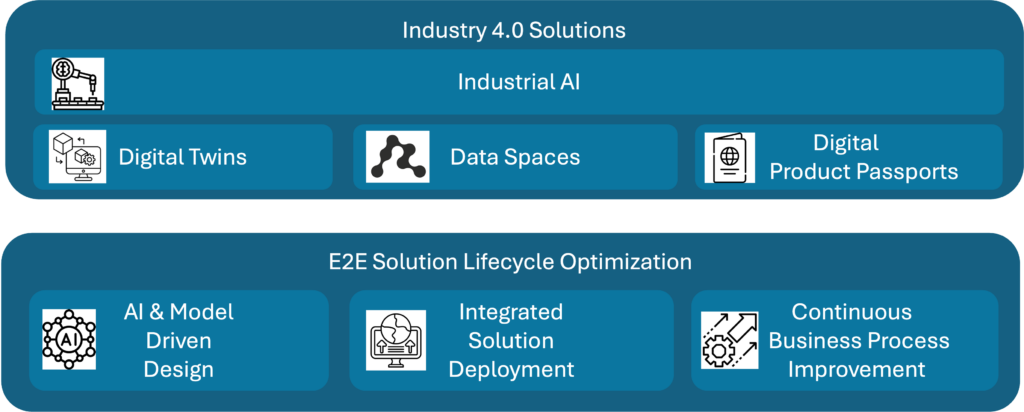
Industry 4.0 Solutions
Industry 4.0 was, and still is, created through a portfolio of initiatives, including Manufacturing-X, that have the goal to make asset-intensive industries more sustainable and resilient, as well as improve the quality of products and processes. This is achieve through standards, blueprints and best practices, defined by a pre-commercial industry ecosystem that is led by technology user organization and invested jointly into improvements in global supply chains.
Industrial AI
Industrial AI build on other Industry 4.0 solution that collect, transform and aggretate data from business systems and the shopfloor. It requires extremly high data quality standards as its insights and potentially even decisions have an direct impact on business operations and the supply chain. Data quality can be achived to the following Industry 4.0 solutions.
We have developed an Industrial AI Readiness Assessment together with research institutes and industry practitioners. It helps you determine your Industrial AI maturity as well show you how many of the required AI capabilities you already have.
Should you decide to work with us on your AI strategy and architecture, we will use a tailored maturity model and prioritied use case list to define your AI roadmap.
Digital Twins
Digital Twins provide a holistic view on assets, products and processes and besides creating transparency into operations also enable process optimization and business model innovation. Besides looking at the Digital Twin Consortium for guidance, we also collaborate with the Industrial Digital Twin Association.
Data Spaces
Data Spaces provide a secure and standard-based data exchange solution where you remain in control of your data, while significantly reducing your integration efforts with customers, partners and suppliers. Here we are actively engaged in the Manufacturing-X ecosystem and especially with Catena-X.
Digital Product Passports
Digital Product Passports (DPPs) provide a standardized data structure for product and material data exchange in a global supply chain. It reduces your efforts to map different data structures between you and your customers, partners and suppliers and keep those mapping up-to-data. Through the standard data structures, it is also easier for AI solutions to consume the data, without a lot of data wrangling. Besides, DPPs will become mandatory for many product categories manufactured or imported in the EU, based on the ESPR regulation.
For our Industry 4.0 Solution Advisory Services a use a consistent approach that makes sure you get the most business value our of your investment.
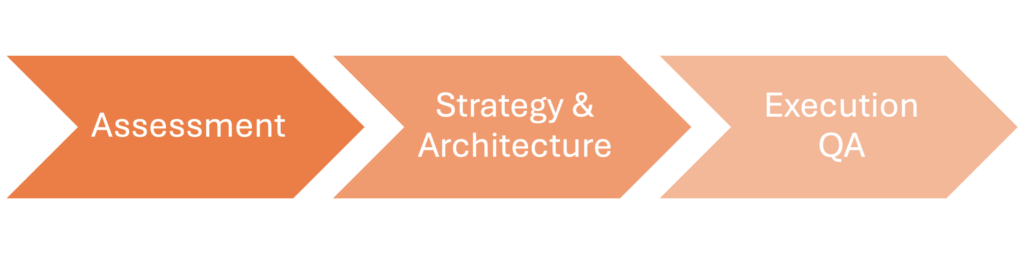
We start with an Assessment of your current situation, determine were you want to be and identify the gap between as-is and to-be. For this we have developed specific maturity models that are based on industry standards and best practices, like CMMI, SFIA, DMM, BPMM and others. The assessment consumes also your information as input and uses AI for a more effective and efficient engagement. Models and AI do not only improve the quality of the assessment and reduces the delivery timeline, but also lowers the cost for you.
The Strategy & Architecture creates a roadmap for you that contains capabilities to build or extend, business value to be created and investment to be done. From this we could co-create an initiative with a project portfolio for you for strategy execution.
Execution QA (quality assurance) for us means that we get hands-on involved in the implementation of the solution from a guidance and review perspective to make sure the projects deliver the business value intended. Many Industry 4.0 solution will be able to use a common set of solution components. This reuse potential needs to be actively unlocked in the analysis and design phase of the solution implementation.
E2E Solution Lifecycle Optimization
While software vendor usually provide really sophisticated development, test and deployment tools, the challenges start when you have and End-To-End Solution that needs functionality and data from 10 or more systems. While the developers are not too much concerned about this and now have co-pilots to improve productity and quality even more, early phases of a E2E solution development, its deployment and operation require a broad set of product, integration and business process management skills.
AI & Model Driven Design
Requirements engineering, business design and E2E solution architecture, are getting more complex the set of systems needed to implement one business use case is growing, as well as the technologies available. Model-driven development and the use of genAI can help in those early phase of solution implementation to increase productity and improve the quality of the solution architecture and design.
Integrated Solution Deployment
In complex E2E solution with many systems, the syncronised and efficient deployment of the whole solution becomes a challenge, as every software product brings its own set of deployment tools. With technologies like containers and the right deployment management platform solution deployment can be for effective and efficient.
Continuous Business Process Improvement
This is not a new topic, but new technology capabilities are able to make this operational challenge easier and the outcomes better. We suggest a combination of process modelling (What do we think is the best process flow), process mining (What does the actual process flow look like), process benchmarking (How is the performance of a best-in-class process) and AI-enabled process reengineering (based on information from the 3 steps before).